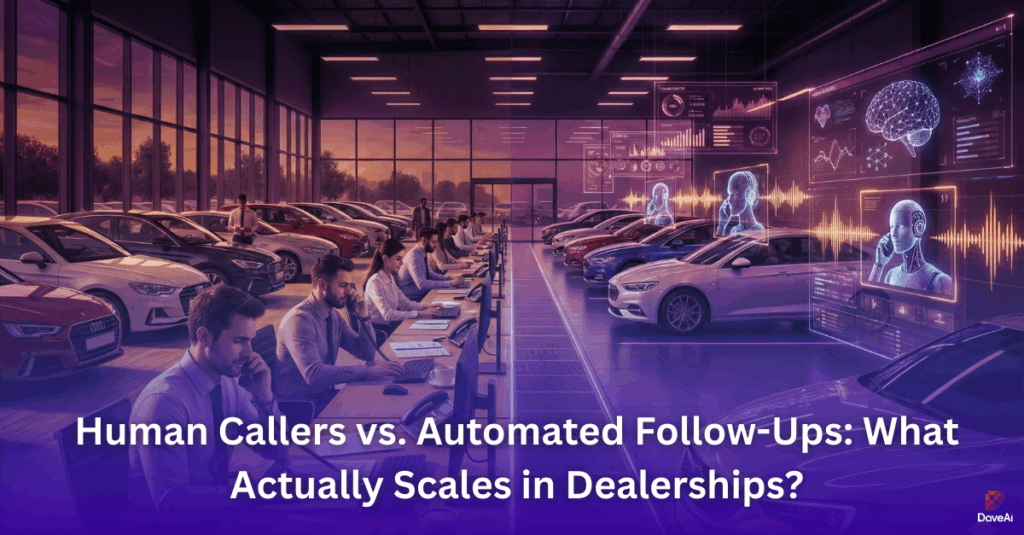
What Happens When a Car Dealership Misses a Call?
At most car dealerships, a missed phone call doesn’t trigger an immediate alarm. It’s easy to assume the inquiry isn’t urgent. Someone on the team might notice the notification later, return the call, and continue with the day. After all, calls are just one of many things happening on a chaotic showroom floor alongside walk-ins, test drives, internal coordination, and follow-ups.
But the automotive retail landscape has changed.
Today, a missed call is no longer just a missed interaction; it is a missed decision. Research indicates that the average automotive business misses 23% of inbound phone calls. At first glance, that percentage might seem manageable until you consider exactly what is on the other end of the line.
The Shift in Automotive Customer Behavior
Today’s car buyer does not call your dealership to browse. By the time they pick up the phone, they have already spent hours online comparing vehicle models, checking pricing, reading dealership reviews, and shortlisting two or three local lots.
The phone call is typically the final step before a purchase decision. Buyers call to confirm a car is in stock, ask about a specific finance offer, or book a test drive. As James O’Neill, CEO of call tracking firm WildJar, explains: “Once they call you they are ready to talk to you, they are ready to purchase, they are as hot as a lead could be.”
If that high-intent call goes unanswered, the customer doesn’t wait. They immediately move to the next dealership on their shortlist. They don’t choose your competitor because they prefer them they choose them purely because they responded.
Why Traditional Callbacks Don’t Work Anymore
Many dealership BDC (Business Development Center) teams rely on the strategy of calling customers back later. But in reality, a callback is a completely different conversation. By the time your sales representative reaches out:
- The customer has likely already spoken to a competing dealership.
- Their purchasing urgency has significantly cooled.
- The context of the conversation has changed.
You are no longer effortlessly part of their decision moment; instead, you are fighting to re-enter it. That is a much harder position to sell from. Studies show that nearly 60% of callers won’t stay on hold for longer than a minute, and most flat-out refuse to wait for a callback. They simply go to the competition.
Where Do Dealerships Actually Miss Phone Calls?
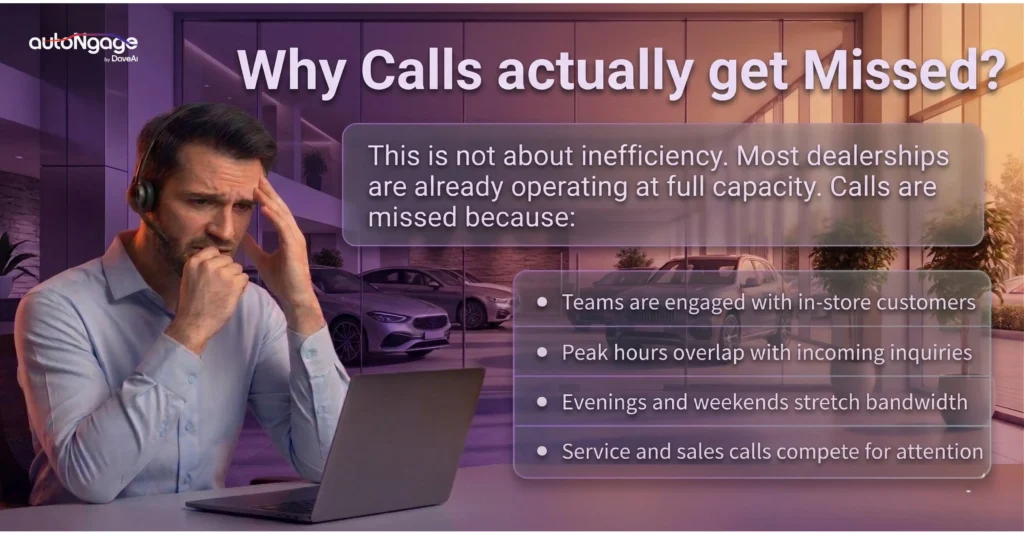
This isn’t an issue of staff inefficiency. Most dealership teams work incredibly hard and operate at full capacity. Calls are typically missed because of structural bottlenecks:
- Sales teams are actively engaged with in-store walk-in customers.
- Peak call hours directly overlap with peak showroom traffic.
- Evenings and weekends stretch staff bandwidth too thin.
- Routine service questions compete with high-value sales calls for attention.
In short, the traditional dealership system is simply not designed to handle every moment of demand.
Data from nearly 600 dealerships reveals that service departments miss an average of 158 calls per month, with some high-volume lots missing up to 216. The busiest, and therefore most vulnerable, window is between 8:00 AM and 11:30 AM a time when service advisors are already stretched thin handling morning drop-offs and check-ins. Historically, Mondays and Tuesdays see the absolute highest call volumes.
The Invisible Dealership Revenue Leak
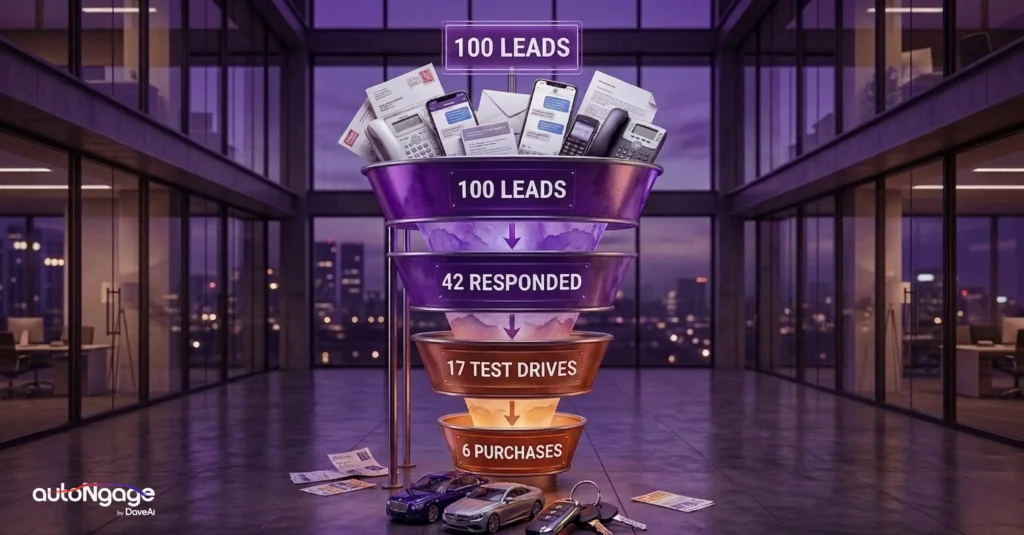
The biggest challenge with missed dealership calls is that they leave no trace. There is no automated report on your manager’s desk that says: “You lost 7 potential car buyers today because the phone rang out.” There is no CRM dashboard showing: “3 customers scheduled service at a competing dealership because nobody answered here.”
Because the loss isn’t immediately visible, it doesn’t feel real. But over time, it adds up quietly and devastatingly.
With the average automotive repair order valued at $450, dealerships missing around 216 service calls per month are looking at between $71,000 and $97,000 in lost service revenue every month. That translates to well over $1 million annually.
This calculation doesn’t even account for the associated waste in marketing spend. One industry analysis found that a single dealership can waste over $53,000 a month on Google Ads alone simply by failing to answer the inbound calls those expensive ads generate.
How Top-Performing Dealerships Handle High Call Volumes
Forward-thinking dealerships have started to view phone calls differently. They no longer see them as a task to be managed, but as a critical conversion moment that must be captured.
Successful General Managers are asking:
- What happens when our primary team is unavailable?
- How do we ensure consistency in every customer conversation?
- Can we respond instantly, even during morning peak loads?
- Can we remove our dependency on timing?
The solution isn’t just hiring more staff. The dealerships fixing this leak are addressing the structural gaps. They are implementing after-hours coverage, utilizing smart overflow handling, and ensuring every single inbound inquiry is acknowledged quickly enough to keep the buyer in the conversation.
(Deep Dive: To see the data on how this structural shift is outperforming traditional methods, read more about Human Callers vs. Automated Follow-ups: What Actually Scales in Dealerships.)

The Real Question: Is Your Dealership Ready?
The root problem is not effort. Dealers and their BDC teams work tirelessly. The core issue is timing the simple fact that customer demand does not align neatly with a showroom’s operational capacity.
If you have never run a proper audit of your dealership’s missed call volume and voicemail return rates, it’s worth doing before drawing any conclusions about your marketing ROI. As one General Manager at Fox Motors discovered, even a top-performing auto group can have one location where over 80% of calls go straight to voicemail, and more than half of those voicemails are never returned.
The revenue is there. The customers are actively calling. The only question now is whether someone or something is there to answer.
Key Takeaways:
- High-Intent Leads: The average automotive business misses 23% of inbound phone calls, losing customers who are ready to buy or book service.
- The Callback Trap: Nearly 60% of callers won’t wait on hold for more than a minute, and most will call a competitor rather than wait for a callback.
- Revenue Leak: A busy dealership missing 216 service calls per month can lose between $71,000 and $97,000 in monthly service revenue.
- The Solution: Top-performing dealerships are shifting away from manual callbacks and structurally removing dependency on timing through automated handling, after-hours coverage, and instant response systems.
Scaling Your Dealership Revenue: Why AutoNgage is the Ultimate Lead Conversion Solution
The most significant challenge in modern automotive retail isn’t just generating leads it’s capturing high-intent buyers at the exact moment they are ready to engage. No matter how much you invest in marketing or staff training, a structural “timing gap” will always exist between customer demand and your showroom’s operational capacity.
AutoNgage was built to bridge this gap by removing the dependency on human timing. Our platform provides an intelligent, always-on layer of dealership sales automation that ensures no inbound inquiry is ever left waiting. Whether you are handling peak-hour surges or after-hours service bookings, AutoNgage scales your capacity instantly transforming every interaction into a captured opportunity and ensuring your dealership’s revenue never leaks through the cracks of a busy showroom floor.
Frequently Asked Questions (FAQs)
On average, automotive businesses miss 23% of inbound phone calls. Data shows that busy service departments can miss between 158 and 216 calls per month primarily due to peak hours overlapping with high showroom traffic.
A dealership missing around 216 calls per month can lose between $71,000 and $97,000 in monthly service revenue. Over the course of a year, this invisible revenue leak can cost a dealership upwards of $1 million in lost repair orders and sales.
Callbacks are no longer effective because modern automotive customers are high-intent buyers. Nearly 60% of callers won’t wait on hold for more than a minute and if a call goes to voicemail, they will usually call a competitor before your BDC team has time to return their message.
The busiest and most vulnerable window for missed calls at a dealership is between 8:00 AM and 11:30 AM. During these morning hours, service advisors are typically stretched thin handling walk-in customers, drop-offs, and check-ins leading to significantly higher missed call rates.
Top-performing dealerships solve the missed call problem by removing the dependency on human timing. Instead of simply hiring more staff, they implement smart after-hours coverage, overflow handling, and automated AI response systems to ensure every inbound inquiry is captured instantly.