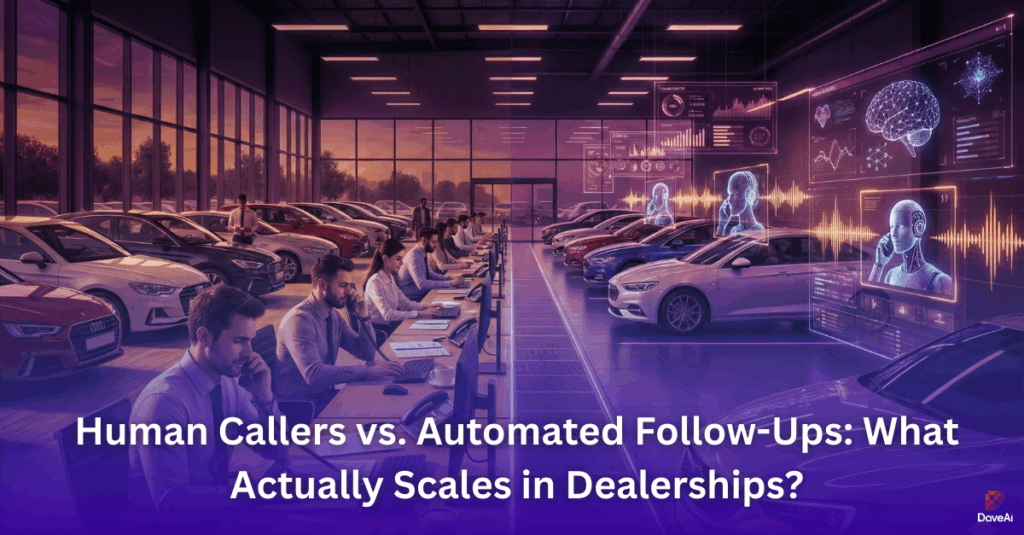
The NADA Show 2026 marked an important milestone for AutoEngage as we formally introduced our dealership-focused engagement platform to the U.S. market.
Held in Las Vegas, the event brought together thousands of dealership leaders, OEM representatives, and technology providers. It gave us an opportunity to showcase our product while also discussing the changing realities dealerships face in operations and meeting customer expectations.
One thing that stood out at NADA this year is that dealerships do not have a problem generating leads, but rather how to manage engagement at all stages of the customer lifecycle as engagement continues to evolve.
The Shift in Dealership Engagement
Over the past several years, dealerships have invested significantly in digital tools. Lead sources have expanded. Communication channels have multiplied. Customer expectations have accelerated. However, engagement systems have often remained fragmented.
Many dealerships today operate across websites, inbound calls, text messaging, third-party marketplaces, CRM systems, and in-store interactions. While each channel may function independently, continuity across the customer journey is frequently inconsistent.
This is where the conversation at NADA became particularly relevant.
Dealers were not asking for more automation. They were asking for better orchestration. They were not seeking generic AI tools. They were seeking systems that understood dealership workflows and supported their teams in real operational contexts.
Introducing AutoNgage to the U.S. Market
AutoNgage by DaveAI was developed specifically to address dealership engagement across the customer lifecycle.
Rather than focusing solely on channel automation (whether voice, chat, or messaging), AutonNgage is built around lifecycle intelligence. It is designed to align engagement with how dealerships actually operate: from inquiry and qualification to appointment setting, follow-up, sales progression, and service retention.
What differentiates AutoNgage is its domain-trained foundation. The platform is structured around automotive-specific workflows, inventory logic, model hierarchies, finance considerations, and dealership response patterns.
This enables conversations that are context-aware rather than scripted. It allows engagement to be personalized based on customer intent, behavior, and stage within the buying journey, not merely triggered by keywords or predefined templates.
In an increasingly crowded AI market, this distinction is critical. AutoNgage is not a generic AI assistant adapted to automotive use. It is built for the dealership ecosystem from the ground up.
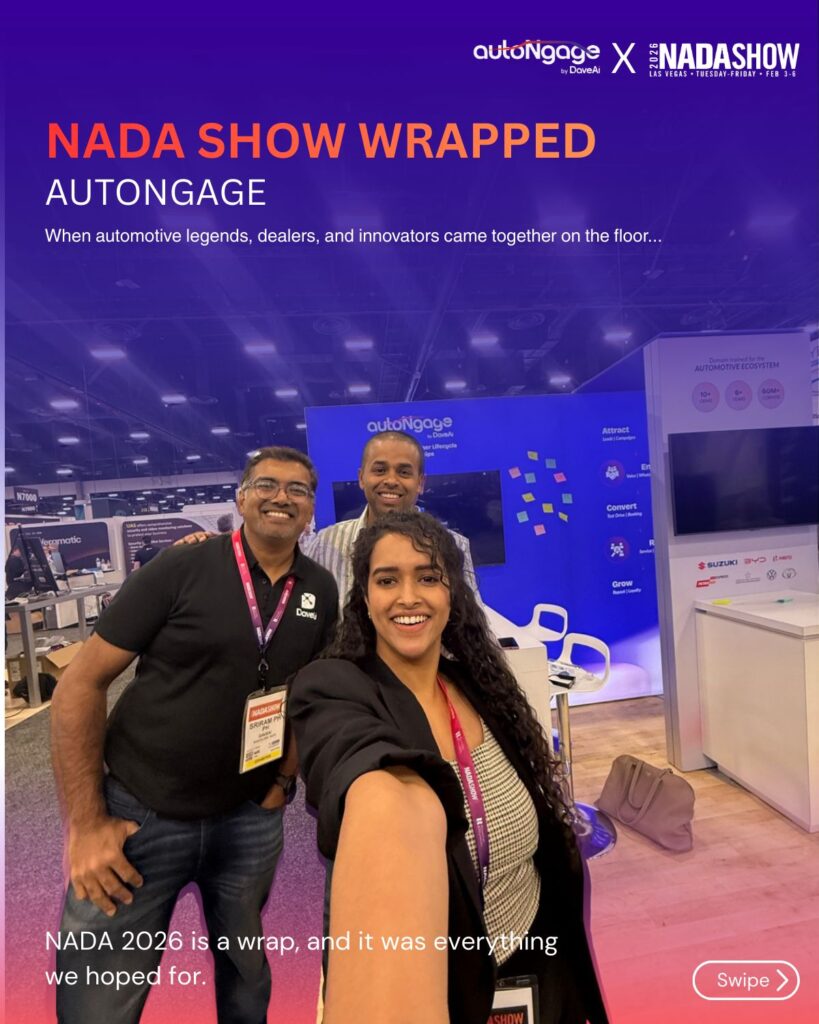
Observations from NADA 2026
Throughout live demonstrations at our booth, discussions consistently centered around three themes:
1. Dealerships require engagement systems that support (rather than replace) their teams. Technology must enhance operational efficiency without introducing additional complexity.
2. Personalization is no longer optional. Customers expect continuity across touchpoints. If a conversation begins online, it must carry context into voice interactions or in-store visits.
3. Intelligence must translate into measurable outcomes. Engagement tools must contribute directly to improved follow-through, higher appointment conversion, and stronger lifecycle retention.
The response to AutoNgage reflected these priorities. Dealers recognized the importance of contextual understanding, predictive prioritization, and unified engagement logic.
Beyond Automation: Lifecycle Intelligence
The automotive AI landscape today includes numerous providers offering chatbots, voice agents, and campaign automation tools. While these solutions address specific communication channels, they often operate in isolation.
AutoNgage approaches dealership engagement differently.
Its architecture is structured around customer lifecycle progression rather than individual channels. Voice, chat, and messaging are aligned within a unified engagement framework. Prioritization is driven by behavioral signals and dealership-defined logic. Follow-ups are timed based on intent rather than fixed schedules.
This enables dealerships to move beyond reactive communication toward proactive, personalized lifecycle management.
Importantly, AutoNgage is designed to operate alongside existing CRM systems and dealership processes. It does not require an operational overhaul. Instead, it introduces an intelligent engagement layer that strengthens current workflows.
The Beginning of U.S. Expansion
The NADA launch represents the first step in AutoNgage’s long-term U.S. strategy.
We are currently engaging with early dealership partners to implement live deployments aligned with U.S.-specific workflows and regulatory considerations. These collaborations will further refine engagement models and ensure that AutoNgage adapts to the operational nuances of American dealerships.
Our objective remains consistent: to help dealerships improve engagement precision, increase conversion efficiency, and support team performance without expanding operational strain.
Dealerships today operate in an environment defined by complexity. Customers expect personalization. Teams require efficiency. Leadership demands measurable outcomes. Meeting these expectations requires more than automation. It requires intelligence embedded across the entire customer lifecycle.
AutoNgage enters the U.S. market with that foundation.
Interested in exploring early access deployments? Schedule a private demonstration: Book a Demo Now.